
Best MTG Apps in 2026: Top Picks for Every Player
July 23, 2026

The best MTG apps cover a lot of ground. Deck building, collection tracking, life counting, card scanning, price monitoring — the strongest tools handle all of it without making you juggle five different apps. Here’s a quick look at the leading options:
Grimoria — All-in-one platform with camera scanning, format-validated deck building, AI-driven budget suggestions, and real-time pricing from TCGPlayer and Cardmarket. Free to use.
MTG Companion — The official Wizards of the Coast app, best for event registration, life tracking, and tournament management.
MTG Familiar — Lightweight offline database with a built-in life counter. No internet required.
ManaBox MTG — Strong collection scanner with multi-market price tracking across TCGPlayer, Cardmarket, Card Kingdom, and Star City Games, plus mana curve stats.
Moxfield — Web-first deck builder with a large community and excellent deck-sharing features.
MTG Manager — Detailed collection management with solid deck validation tools.
TopDecked MTG — Competitive-focused deck builder with direct marketplace price alerts.
Deckbox — Web-based trade and collection manager with CSV import/export.
Archidekt — Modern online deck builder with a clean interface and social features.
GrimDeck — Format legality checking built for tournament players.
Magic Life Counter — Simple, clean life tracking with multiplayer support.
MTG Card Scanner Delver Lens — High-accuracy OCR scanning for rapid batch card entry.
MTG Unofficial — Offline card database and deck builder with complete card info.
EchoMTG — Community-driven collection and deck management with deck sharing.
Dragon Shield MTG Scanner — Scanning app optimized for Dragon Shield sleeves and MTG cards.
CardCastle — Price-focused collection tracker with integrated marketplace links.
Table of Contents
What are the best MTG apps for deck building and collection management?
Why real-time price tracking changes how you manage your collection
What are the best MTG apps for deck building and collection management?
Sixteen apps made this list. They don’t all deserve the same word count. Some have genuinely distinct strengths; others fill a narrow niche. The table below maps each one against the dimensions that actually matter when you’re choosing.
AppBest ForKey FeaturesPrice TrackingOfflineCollection MgmtDeck ValidationPlatformsGrimoriaAll-in-one players and collectorsCard DB, deck builder, AI suggestions, camera scan, trade toolsTCGPlayer, Cardmarket—YesYes (format validation)iOS, AndroidMTG CompanionCasual and tournament playersLife counter, event registration, game tracking—Partial——iOS, AndroidMTG FamiliarOffline card search and life trackingCard DB, life counter, rulings—Yes——AndroidManaBox MTGCollectors tracking prices and deck statsCamera scan, mana curve, deck simulationTCGPlayer, Cardmarket, Card Kingdom, SCGYesYesYesiOS, AndroidMoxfieldCollaborative deck buildingDeck sharing, precon comparisons, large community———YesWebMTG ManagerSerious collection and deck managementCollection tracking, deck validation, detailed stats——YesYesiOS, AndroidTopDecked MTGCompetitive players watching market pricesPrice alerts, marketplace integration, meta toolsYes——YesiOS, AndroidDeckboxTrade-focused collectorsTrade tracking, CSV import/export, wishlists——Yes—WebArchidektStylish deck building with community inputImport/export, social features, clean UI———YesWebGrimDeckTournament format complianceFormat legality checking, deck export———YesWebMagic Life CounterQuick multiplayer life trackingMultiple player counters, clean design—Yes——iOS, AndroidMTG Card Scanner Delver LensRapid batch card entryAdvanced OCR, fast scanning——Yes—iOS, AndroidMTG UnofficialOffline card data accessFull card DB, deck builder, no internet needed—Yes—YesAndroidEchoMTGSocial deck sharing and personalizationDeck sharing, notifications, community features——Yes—WebDragon Shield MTG ScannerDragon Shield product integrationOptimized scanning for Dragon Shield sleeves——Yes—iOS, AndroidCardCastlePrice tracking and purchasingMarketplace links, real-time card valuesYes—Yes—iOS, Android
Grimoria
Grimoria’s core pitch is consolidation. Instead of running a separate scanner, a separate price tracker, and a separate deck builder, everything lives in one place. The camera-based card scanning feeds directly into your collection, which then syncs with real-time pricing from TCGPlayer and Cardmarket. The deck builder validates format legality, and an AI layer suggests budget-friendly alternatives when a card is out of your price range. For players who also trade, there’s a dedicated trade and sell list manager with import/export compatibility for other tools. It’s free to use, with affiliate revenue from marketplace links keeping the lights on.
MTG Companion
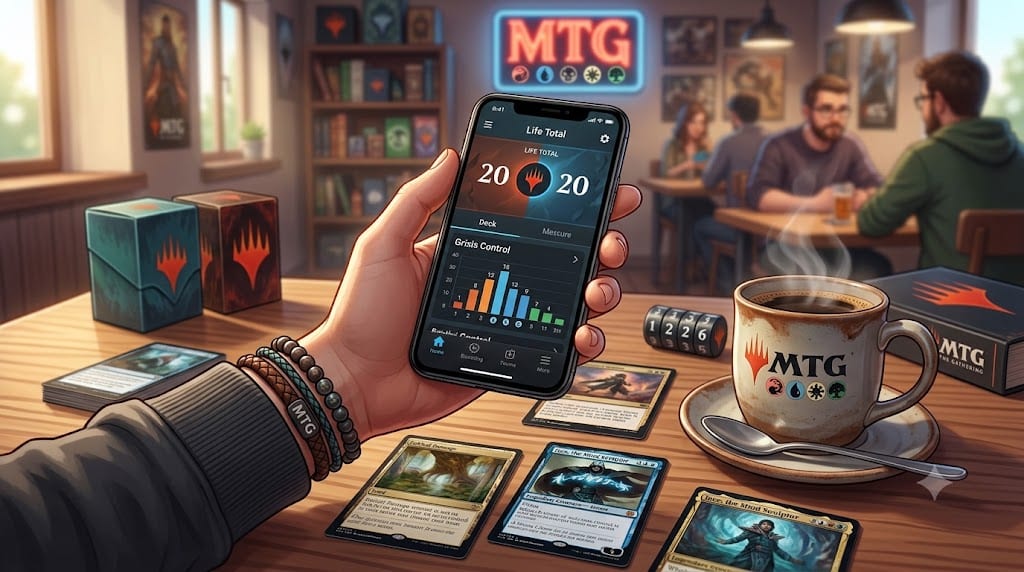
This is the official app from Wizards of the Coast, which gives it one thing no third-party tool can replicate: direct event integration. You can register for tournaments, track your match results, and manage life totals all in one place. The life counter supports commander damage and poison counters. What it doesn’t do well is collection management or price tracking. Think of it as the app you open at a Friday Night Magic event, not the one you use to manage your binder.

MTG Familiar
MTG Familiar is the go-to for Android players who want a solid offline experience. The card database is complete, rulings are included, and the life counter works without a data connection. The interface is functional rather than polished, but that’s a fair trade for something that works reliably on a plane or in a basement with no signal.
ManaBox MTG
ManaBox punches above its weight on price data. It pulls from TCGPlayer, Cardmarket, Card Kingdom, and Star City Games simultaneously, which gives you a more complete picture of what your cards are actually worth than apps that rely on a single marketplace. The camera scanning is fast, the mana curve visualization is genuinely useful during deck building, and the deck simulation tools help you stress-test a list before you sleeve it up.
Moxfield
Moxfield is the deck builder most competitive players already use as their primary list-management tool, even if they use other apps for everything else. The community deck library is enormous, preconstructed deck comparisons are built in, and the import/export options are the most flexible of any web-based tool. It’s web-only, which is a real limitation if you want to reference your list at the table without a browser open.
MTG Manager, TopDecked MTG, and Deckbox
These three serve distinct audiences. MTG Manager is for players who want granular collection data and strict deck validation in a mobile app. TopDecked MTG is built around price alerts and marketplace integration, making it the better choice for players who actively buy and sell based on meta shifts. Deckbox is the oldest of the three and remains the standard for trade tracking, with CSV import/export that makes it easy to move data in and out.
Archidekt and GrimDeck
Archidekt’s interface is the most visually appealing of the web-based deck builders. The social layer lets you comment on and share decks, and the import/export flexibility means you’re never locked in. GrimDeck takes a narrower focus: format legality checking and clean deck export for tournament play. If you’re building for a competitive event and need to be certain your list is legal, GrimDeck handles that job well.
Life counter and scanning apps
Magic Life Counter does one thing and does it cleanly: track life totals for multiple players, including commander damage. MTG Card Scanner Delver Lens is the strongest standalone scanning option, using advanced OCR to process cards quickly in batch mode. Dragon Shield MTG Scanner is purpose-built for collectors using Dragon Shield sleeves, with scanning optimized for that specific product line.
MTG Unofficial, EchoMTG, and CardCastle
MTG Unofficial is the best offline option for players who want a complete card database without any internet dependency. EchoMTG leans into community features, with deck sharing and customized notifications that appeal to players who want a social layer around their collection. CardCastle focuses on price tracking and purchasing, with integrated marketplace links that make it easy to go from browsing your collection to buying a missing card.
How do you choose the right MTG app for your needs?
The honest answer is that most players end up using two or three apps, not one. But you can narrow the field quickly by being clear about what you actually do most.
Start with your primary use case. If you spend most of your time building and refining decks, a tool with strong format validation and import/export flexibility matters more than camera scanning. If you’re primarily a collector tracking what your binder is worth, real-time price data from multiple markets is the feature you can’t compromise on. If you play Commander at a kitchen table every Friday, a reliable life counter with commander damage tracking is the one thing you need to get right.
Player profiles and what they should prioritize:
Casual players — Life counter functionality, offline usability, and a clean interface. MTG Companion or Magic Life Counter handle the basics. MTG Familiar works well if you’re on Android and often play without a signal.
Competitive players — Format validation, meta tools, and price alerts. TopDecked MTG and GrimDeck are built for this. Moxfield is the standard for list management at this level.
Collectors — Multi-market price tracking, camera scanning, and trade management. ManaBox MTG and Grimoria are the strongest options here, with Deckbox adding depth for trade tracking.
All-around players — If you build decks, track a collection, and play regularly, a unified tool saves real time. Grimoria covers all three without requiring you to sync data between separate apps.
Platform compatibility matters more than it sounds. Several strong tools, including Moxfield, Archidekt, Deckbox, and EchoMTG, are web-only. That’s fine for desktop use, but if you want to pull up your deck list at a tournament or scan cards at a trade table, you need something that runs natively on iOS or Android.
Offline functionality is underrated. Card databases go stale, apps crash, and venues don’t always have reliable Wi-Fi. MTG Familiar, MTG Unofficial, and ManaBox MTG all offer meaningful offline support. If you play in environments where connectivity is unreliable, that’s worth weighting heavily.
Developer support and update frequency directly affect how useful an app stays over time. Magic releases new sets constantly, and an app with a stale card database is actively misleading. Regular updates keep card data, rulings, and format legality current, which is a practical requirement rather than a nice-to-have.
Pro Tip: Don’t evaluate apps based on feature lists alone. Download two or three candidates and try scanning the same ten cards, building the same deck, and checking the same card’s price across each one. The differences in speed and accuracy become obvious fast.
Why real-time price tracking changes how you manage your collection
A card’s value in Magic: The Gathering can shift dramatically in days, sometimes hours, when a new set drops or a card gets banned or unbanned. Tracking prices manually across TCGPlayer, Cardmarket, Card Kingdom, and Star City Games is genuinely impractical. Apps that pull multi-market price data in real time solve a problem that used to require multiple browser tabs and a spreadsheet.
The practical benefits go beyond knowing what your collection is worth today:
Accurate collection valuation — A single-market price can be misleading. A card priced at $40 on TCGPlayer might be $28 on Cardmarket. Multi-market data gives you a realistic range.
Smarter trading decisions — When you know the current spread across markets, you can negotiate trades from an informed position rather than guessing.
Budget deck building — Price-aware deck builders can flag when a card you’ve added spikes your budget and suggest alternatives at a lower price point. Grimoria’s AI-driven budget suggestions work this way.
Sell timing — Tracking 90-day price history helps you identify whether a card is trending up or has already peaked. Selling at the right moment is the difference between getting $15 and $8 for the same card.
Meta awareness — Price movement often signals meta shifts before tournament results are published. A card quietly climbing in price usually means someone has figured out a new use for it.
Multi-market integration is now a baseline expectation for serious collection apps. Tools that pull from only one marketplace are leaving meaningful data on the table.
Key Takeaways
Grimoria stands out as the strongest all-in-one option for players who want deck building, collection tracking, and real-time price monitoring in a single free app.
PointDetailsMatch the app to your roleCasual players need a life counter; collectors need multi-market pricing; competitive players need format validation.Multi-market price data mattersApps pulling from TCGPlayer, Cardmarket, Card Kingdom, and Star City Games give more accurate valuations than single-source tools.Offline support is a real factorMTG Familiar, MTG Unofficial, and ManaBox MTG work without a connection, which matters at venues with unreliable Wi-Fi.Web-only tools have limitsMoxfield, Archidekt, and Deckbox are excellent at the desktop but can’t replace a native mobile app at the table.Grimoria covers the full stackFree to use, with camera scanning, format-validated deck building, AI budget suggestions, and real-time pricing from TCGPlayer, Cardmarket, Card Kingdom, and Star City Games.
The case for fewer apps, not more
Most MTG players I’ve talked to end up with four or five apps installed and actively use maybe two of them. That’s not a failure of discipline. It reflects a real gap in the market: most tools do one or two things well and leave you to fill in the rest elsewhere.
The conventional wisdom is to pick the best tool for each job. Use Moxfield for deck building, ManaBox for scanning, TopDecked for price alerts, MTG Companion for events. That approach works, but it has a hidden cost: your data lives in four different places. Your collection value in ManaBox doesn’t talk to your deck budget in Moxfield. Your price alerts in TopDecked don’t connect to your trade list anywhere.
What actually changes the experience is when those functions share a data layer. When your scanned collection automatically informs your deck builder’s budget, and your price tracking updates the same collection you’re building from, the whole workflow gets faster. That’s the argument for a unified tool, and it’s why the app category is moving in that direction.
The other thing worth saying: developer support matters more in this hobby than in most. Magic releases new sets on a tight schedule, and a card database that’s two sets behind is actively wrong, not just incomplete. An app that gets regular updates isn’t a bonus feature. It’s a minimum requirement.
Grimoria brings it all together in one free tool
If the comparison above left you wanting one app that handles collection scanning, deck building, price tracking, and trade management without a monthly fee, Grimoria is the direct answer. It’s built specifically for active Magic players and collectors who are tired of switching between tools.
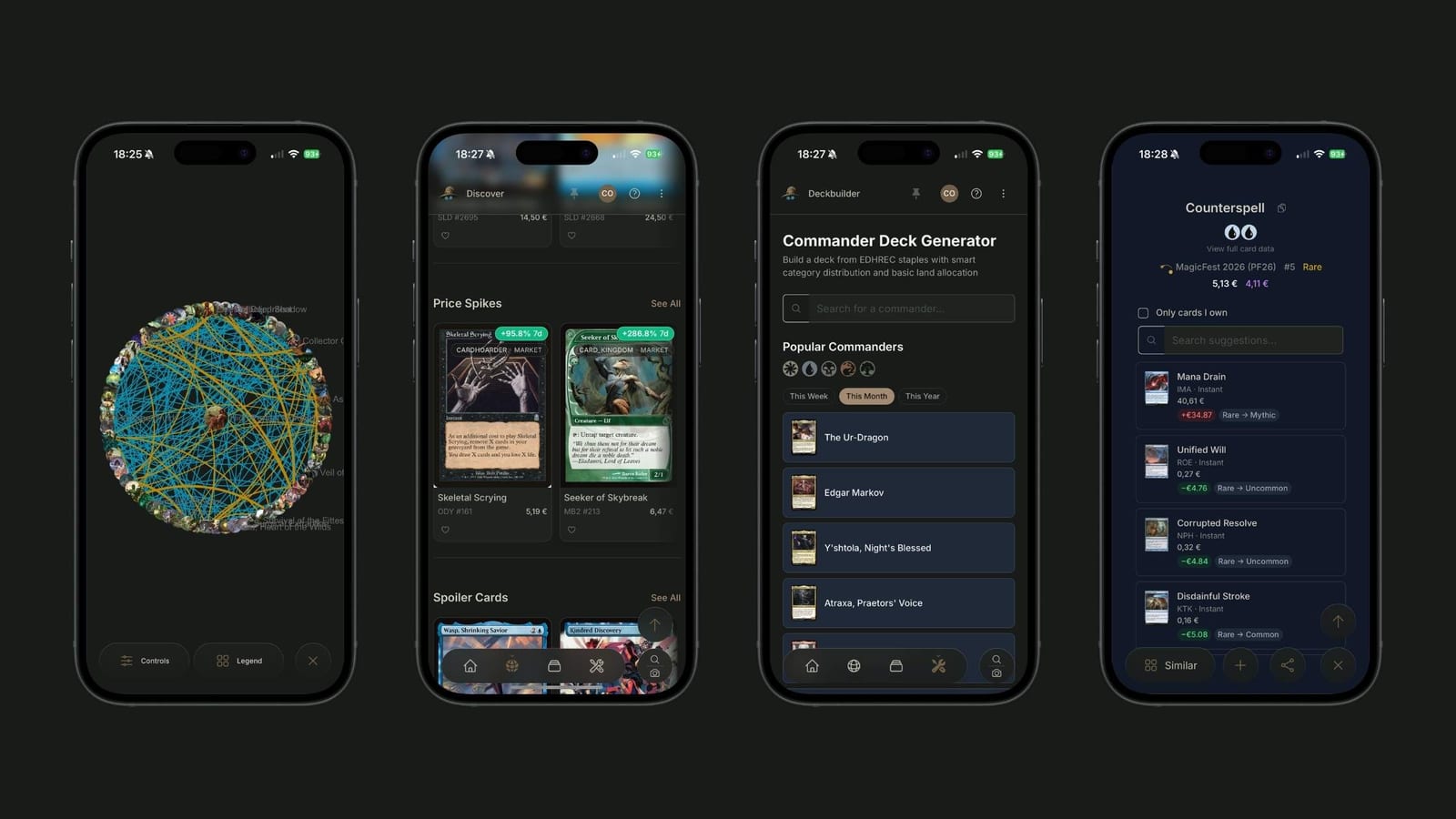
Grimoria’s camera scanner adds cards to your collection in seconds. The deck builder validates format legality across Commander, Standard, Modern, and other formats. Real-time pricing from TCGPlayer, Cardmarket, Card Kingdom, and Star City Games keeps your collection valuation current, and the AI layer suggests budget alternatives when a card is pushing your deck over your target spend. Trade lists, sell lists, and import/export compatibility with other tools are all included.
It’s free to use. Start building your collection on Grimoria today and see how much simpler the whole workflow gets when everything lives in one place.