
MTG Deck Building: A Practical Guide for Every Format
July 31, 2026
MTG deck building is the intentional process of crafting a cohesive 60-card deck with a defined strategy, where every card earns its slot by advancing a single clear goal. Before you touch a card database or start sleeving up, you need a mission statement. Not a vague theme. A real one: “I’m playing a red-white aggro deck that wins before turn five by flooding the board with cheap creatures and finishing with burn.” That sentence alone will answer most of your card selection questions before you even ask them.
Here’s what every deck needs from the start:
A format decision (Standard, Modern, Commander, Pioneer, Limited) because the legal card pool and deck size change everything
A color identity of one or two colors to keep your mana base manageable
A win condition that every card either enables or protects
A land count baseline of 24 lands for a 60-card deck, adjusted after playtesting
Card type distribution across threats, removal, and interaction
Pro Tip: Write your mission statement on a sticky note before opening any deck builder. Every card you consider gets one question: does it help this deck do its thing? If the answer is “well, it’s a good card,” it probably doesn’t belong.
Table of Contents
Core principles that govern MTG deck building
The official rules are simple. A standard 60-card deck runs a minimum of 60 cards in the main deck and up to 15 cards in the sideboard. You can run at most four copies of any non-basic land card. Commander is the exception: 100 cards, one copy of each, built around a legendary creature.
Beyond the rules, the principles are where most players go wrong.
Mana base first, always. A baseline of 24 lands is the standard starting point for 60-card decks, with typical counts ranging from 21 to 26 depending on your curve and strategy. Aggressive decks with cheap spells can drop to 21 or 22. Control decks that need to hit land drops through turn six or seven often want 25 or 26. Getting this wrong is the single most common reason decks underperform.
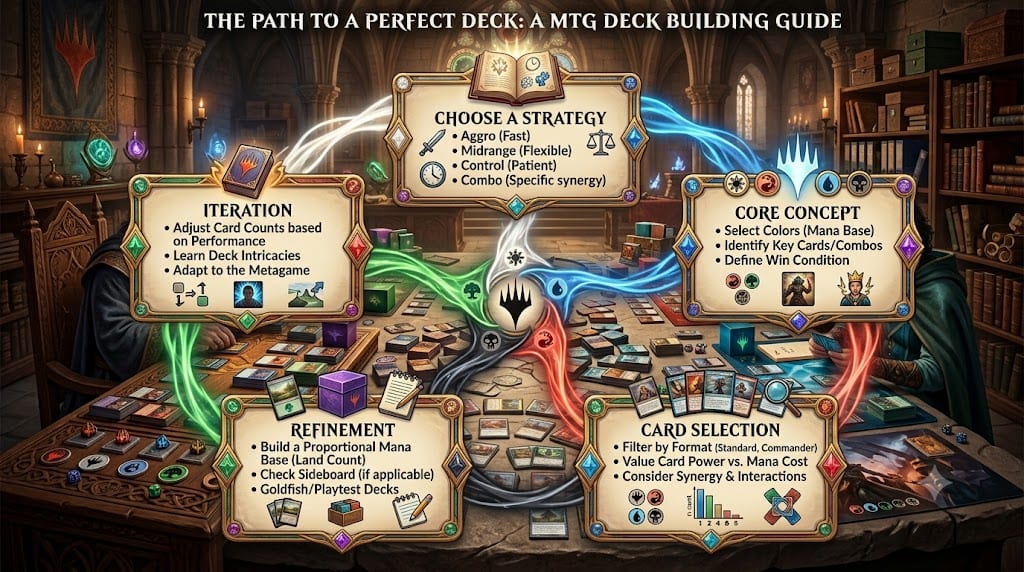
Stay close to 60 cards. Every card you add past 60 reduces your odds of drawing your best cards. The math is unforgiving. A 75-card deck doesn’t give you more options; it gives you more variance, and variance is the enemy of consistency.
Core rules at a glance:
Minimum 60 cards in the main deck (100 for Commander)
Maximum 4 copies of any non-basic land card
Up to 15 cards in the sideboard for constructed formats
Land counts typically 21–26 depending on deck type
Every card should serve the deck’s primary strategy
“Every card in your deck should have a reason to be there, contributing directly to the deck’s mission statement to avoid incoherence.” — Wizards of the Coast, My Most Important Deck-Building Rule
Mana curve matters too, but not in the rigid way most beginners think. You want spells at multiple mana values so you’re doing something useful every turn, not a perfectly symmetrical bell curve. A deck with twelve two-drops, eight three-drops, and four four-drops can be excellent. A deck with three of everything from one to seven is usually a mess.
How deck archetypes shape your strategic goals
Magic’s four major archetypes are Aggro, Control, Midrange, and Combo. Each one has a fundamentally different win condition and a different relationship with time.
Aggro decks want the game over fast. They play cheap, efficient threats and attack before the opponent stabilizes. A mission statement: “I’m a red-white aggro deck that wins by turn four through creature pressure and burn spells.” Every card that doesn’t advance that clock is a liability.
Control decks play the long game. They answer threats, draw cards, and win with a single powerful finisher after the opponent runs out of resources. Mission statement: “I’m a blue-black control deck that survives until turn eight, then wins with a single threat the opponent can’t answer.” Control players measure success in card advantage, not damage.
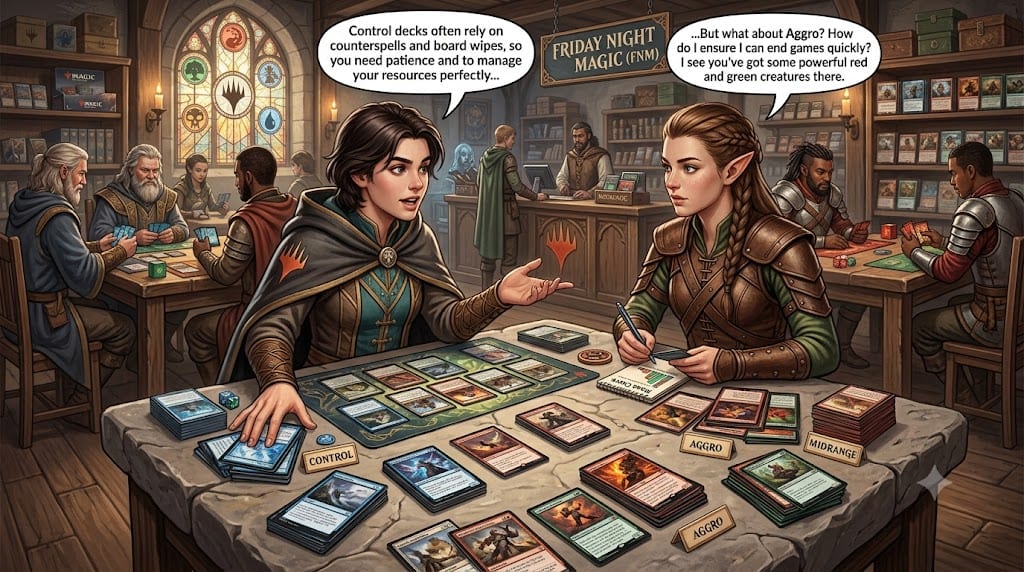
Midrange decks sit between the two. They play efficient threats that are hard to answer and trade resources favorably. Mission statement: “I’m a green-black midrange deck that plays a threat every turn from two through five and grinds the opponent out of cards.” Midrange is often the most forgiving archetype for newer players because it doesn’t demand perfect sequencing.
Combo decks assemble a specific combination of cards that wins the game on the spot. Mission statement: “I’m a deck that assembles two specific cards to create an infinite loop and win immediately.” Combo demands consistency above all else, which means running four copies of every key piece and plenty of card draw to find them.
“Magic strategies can be seen as the push-and-pull of simply trying to kill the opponent as quickly as possible versus killing more slowly, but interacting with the opponent’s cards along the way.” — Wizards of the Coast, Strategies
Knowing your archetype before you build is what separates a focused deck from a pile of individually good cards. A midrange deck that tries to also win by turn three is neither a good midrange deck nor a good aggro deck.
Which tools actually help you build better decks?
Digital deck building tools have gotten genuinely good. The best ones do more than let you list 60 cards; they validate your deck against format legality, show your mana curve visually, track card prices, and flag when you’re running illegal copies.
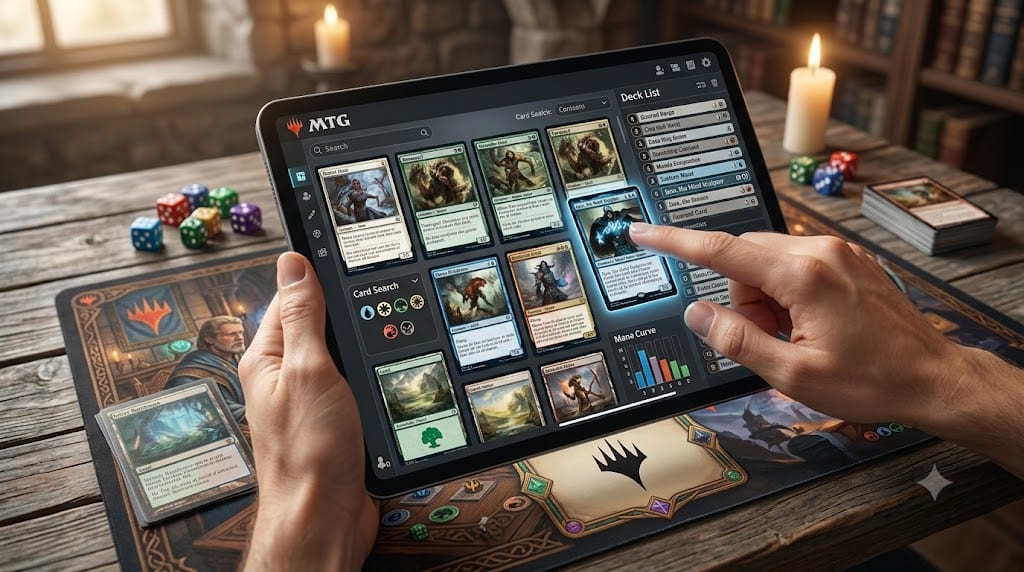
Grimoria is the all-in-one option worth knowing. It combines a full MTG card database, a deck builder with format validation, collection and binder management, camera-based card scanning, and price tracking from both TCGPlayer and CardMarket. The AI budgeting feature suggests cheaper alternatives when you’re building on a budget, which is genuinely useful when you’re trying to keep a competitive deck under a specific price point. You can also import and export decklists from other tools, so switching doesn’t mean starting over.
Key features to look for in any deck building tool:
Format validation that flags illegal cards automatically
Mana curve visualization so you can see your distribution at a glance
Price tracking integrated with real marketplaces
Card search with filtering by color, type, mana cost, and set
Collection management so you know what you already own
Import/export compatibility with other platforms
Pro Tip: Use the mana curve display in your deck builder after every major revision. A curve that looks balanced in your head often reveals gaps or spikes when you see it visually. Catching a missing two-drop slot before you sit down to play saves a lot of frustration.
Grimoria’s card encyclopedia also includes rulings and card history, which matters more than people expect. Knowing exactly how a card interacts with a specific mechanic can change whether it belongs in your deck at all.
How to find inspiration and improve your deck over time
The fastest way to improve a deck is to play it, lose with it, and figure out exactly which cards were dead in your hand when you lost. That sounds obvious, but most players skip the analysis part.
Community decklists are a legitimate starting point. Browsing successful builds in your format shows you what the metagame looks like and which cards are pulling weight. The key is to adapt, not copy. A top-performing Standard deck built for a $500 budget doesn’t help you if you’re working with $80. Take the skeleton, understand why each card is there, and find budget alternatives that serve the same function.
Playtesting methods that actually work:
Goldfishing: play your deck alone against an imaginary opponent to see how consistently you execute your game plan
Best-of-three matches: always playtest in the same structure you’ll compete in, because sideboard games reveal weaknesses the first game hides
Tracking dead cards: note which cards you never wanted to draw in specific matchups; those are your first cuts
Mana curve review: after 10 games, check whether you’re consistently mana-flooded or mana-screwed and adjust land count accordingly
Community resources worth using regularly include MTG subreddits, local game store Discord servers, and format-specific forums where players post detailed matchup analyses. The feedback you get from someone who has played 200 games in your format is worth more than any single article.
Incremental tuning beats wholesale rebuilding. Change one or two cards at a time, playtest again, and measure the difference. Swapping six cards at once makes it impossible to know which change actually helped.
Expert insights that most players overlook
The “good stuff” trap is where most intermediate players stall out. You’ve learned the rules, you know the archetypes, and now you’re building decks full of individually powerful cards that don’t quite work together. The mission statement principle exists specifically to prevent this. A card that’s objectively powerful but doesn’t advance your specific game plan is a liability, not an asset.
“Avoid the ‘good stuff’ trap by prioritizing synergy and mission alignment over simply including individually powerful cards; this focused approach leads to consistently stronger decks.” — Wizards of the Coast, My Most Important Deck-Building Rule
Land count adjustments deserve more attention than they get. Utility lands and creature-lands add value beyond just producing mana, which means running slightly more lands than you might otherwise can actually increase your effective spell count. A land that becomes a 3/3 creature in the late game isn’t a dead draw.
On mana curves: strict curve theories can mislead you. Chasing a perfect bell-shaped distribution sometimes means including mediocre cards just to fill a mana slot. A high-quality four-drop is better than a weak two-drop you added to “fix the curve.” Evaluate cards on their power and synergy first, then check whether the curve still makes sense.
Pro Tip: When evaluating a card for your deck, ask two questions: does it help you execute your game plan, and does it do something useful when you’re behind? Cards that only shine when you’re already winning are the first to cut.
Sideboarding discipline separates good players from great ones. The instinct after a loss is to add more answers. Resist it. Over-sideboarding dilutes your core strategy and turns game two into a worse version of your main deck. Bring in cards that address specific threats; take out cards that are dead in the matchup. Keep the ratio tight.
Sideboarding strategies and adapting your deck post-match
A well-constructed sideboard is 15 cards with a plan, not 15 cards that seemed useful. Build your sideboard around the three or four most common matchups in your format, then fill the remaining slots with flexible answers that work across multiple situations.
The mechanics of sideboarding well:
Identify which of your main deck cards are dead or weak in each major matchup
Bring in cards that address your opponent’s specific threats, not generic “good” cards
Swap equal numbers in and out to maintain deck size
Don’t over-board: bringing in eight new cards usually means your deck loses its identity
After game one, you have information. Your opponent showed you their deck’s strategy, their removal suite, and their win condition. Use that. If they’re playing a heavy removal deck, bring in threats that are harder to answer. If they’re playing a combo deck, bring in disruption. The sideboard is your adaptation tool, not a backup deck.
One underused sideboard approach: boarding for your opponent’s sideboard. If you know they’ll bring in graveyard hate against you in game two, you can either reduce your graveyard reliance or bring in cards that punish that hate.
Format-specific considerations that change how you build
Every format has its own construction rules, and building without knowing them is how you end up with an illegal deck at your first tournament.
Standard uses only cards from recent sets, rotating annually. The card pool is smaller, which makes it easier to understand the metagame but harder to find budget options since every playable card is in print. Minimum 60 cards, 15-card sideboard for best-of-three.
Modern is non-rotating and goes back to 2003, which means a massive card pool and a deeply established metagame. Decks are faster and more powerful than Standard. The format rewards knowing the metagame well because the same decks have been refined for years.
Commander is 100 cards, exactly one copy of each non-basic land card, built around a legendary creature that defines your color identity. The social contract matters here as much as the rules: a deck optimized to win on turn three is legal but unwelcome at most tables. Commander rewards political play and big, splashy cards.
Pioneer sits between Standard and Modern, using cards from 2012 onward. It’s a good middle ground for players who want a non-rotating format without the price tag of Modern staples.
Limited (Draft and Sealed) uses a 40-card minimum built from booster packs. Card evaluation works differently here: a card that’s mediocre in Constructed can be excellent in Limited because the power level of the card pool is lower. Mana fixing is harder, so two-color decks are usually the right call.
How to identify card synergy and combo potential
Synergy is when two cards together do more than either does alone. Combo is when two or more cards create an effect that wins the game immediately. Knowing the difference matters because you build around them differently.
Finding synergies starts with asking what your cards want. A card that generates tokens wants cards that benefit from having many creatures. A card that cares about your graveyard wants cards that fill it. Work backward from your win condition and map which cards accelerate it.
Practical techniques for identifying synergy:
Read the card carefully: look for triggered abilities, replacement effects, and conditional bonuses that other cards in your deck might trigger
Search by mechanic: use a card database to find all cards with a specific keyword or ability, then check which ones overlap with your strategy
Check ruling interactions: some card interactions only work because of specific rules; Grimoria’s card encyclopedia includes rulings that clarify these
Test before committing: a synergy that looks good on paper sometimes doesn’t work in practice because the pieces don’t come together consistently enough
Combo identification is similar but stricter. A combo needs to be consistent enough to assemble reliably, fast enough to matter, and resilient enough to survive disruption. If your combo requires three specific cards and you’re only running two copies of one of them, it’s not a real combo plan. Run four of every critical piece and enough card draw to find them.
Budget deck building that actually competes
Budget deck building isn’t about settling for worse cards. It’s about finding the overlap between “affordable” and “effective in my specific strategy.”
The most reliable budget approach is to pick an aggressive or synergy-based strategy where the individual cards don’t need to be expensive to be effective. Mono-red aggro, for example, can be built competitively in Standard for a fraction of the cost of a control deck because the cards it needs are cheap to cast and cheap to buy.
Budget-friendly principles:
Avoid multi-color mana bases: dual lands are expensive; one or two colors keeps your land costs low
Focus on synergy over raw power: a card that costs $0.50 and fits your strategy beats a $15 card that doesn’t
Use AI budgeting tools: Grimoria’s AI feature suggests budget alternatives to expensive staples, which is genuinely useful when you’re trying to keep a deck under a price ceiling
Buy singles, not packs: buying the specific cards you need is almost always cheaper than opening packs hoping to find them
Start with a preconstructed deck: Wizards of the Coast releases preconstructed Commander and Standard decks that are playable out of the box and upgradeable over time
The biggest mistake budget builders make is spreading their money across too many cards instead of maximizing copies of their best ones. Four copies of a $3 card that’s central to your strategy is better than one copy each of four $3 cards that don’t connect.
Grimoria brings your whole collection into one place
If you’re serious about building better decks, the tool you use to manage your collection and build your lists matters. Grimoria is built specifically for MTG players who want everything in one place: a full card database, a deck builder with format validation, collection and binder management, camera-based card scanning, and real-time price tracking from TCGPlayer and CardMarket.
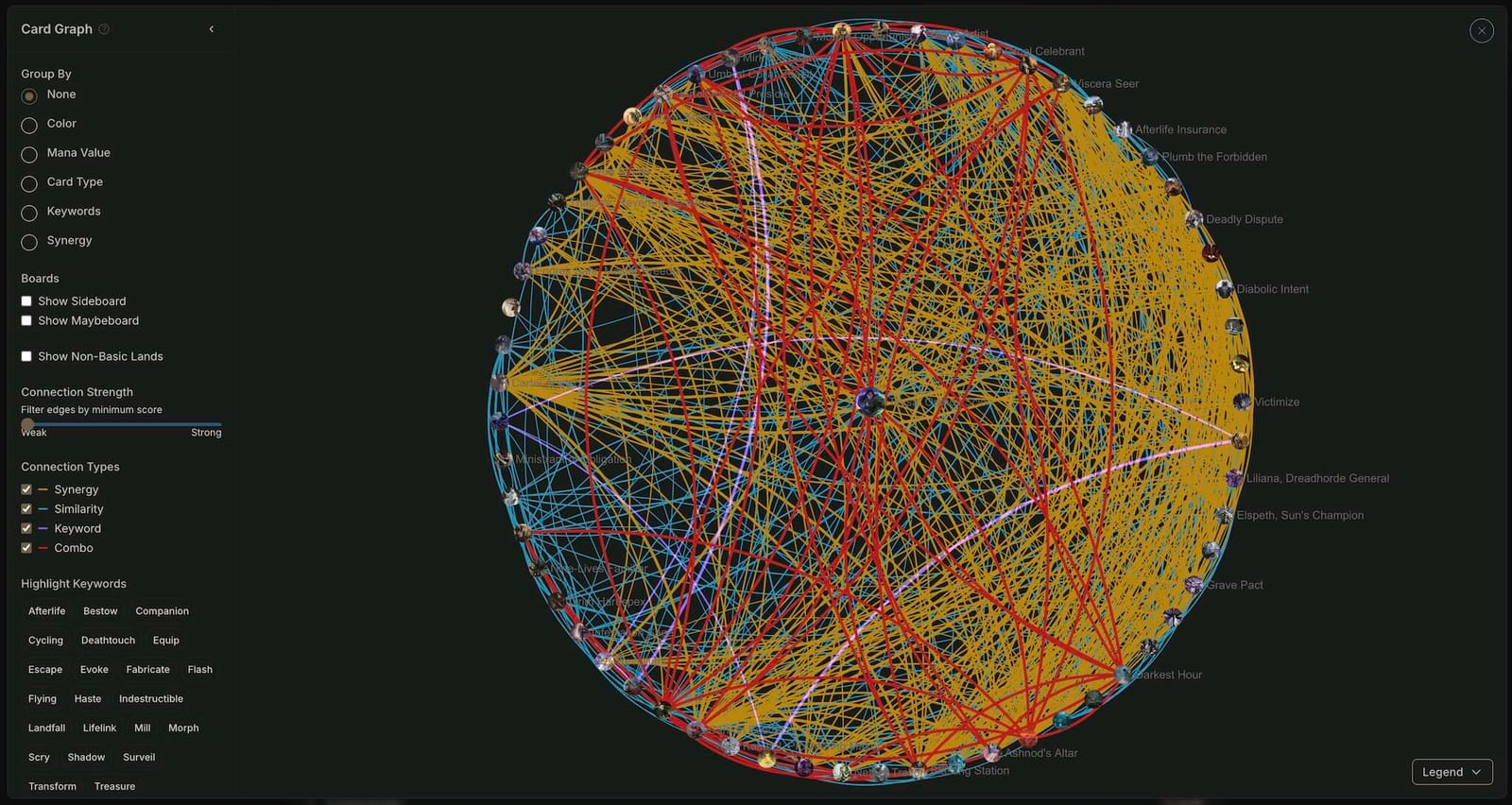
The AI budgeting feature is where Grimoria stands apart from basic deck builders. When you’re building toward a competitive list but working within a budget, it suggests specific card alternatives that fit your strategy without blowing your price ceiling. You can also import existing decklists from other platforms, manage trade and sell lists, and access card rulings directly inside the app. For players who track a collection across multiple formats and want to know exactly what they own and what it’s worth, Grimoria handles all of it without requiring three separate tools. Head to grimoria.app to start building your first deck or import a list you’re already working on.
Key Takeaways
A focused mission statement is the single most important element of a well-built MTG deck, because it determines which cards belong and which ones don’t.
PointDetailsStart with a mission statementDefine your deck’s goal in one sentence before selecting any cards.Land count baselineRun 24 lands in a 60-card deck; adjust to 21–26 based on your mana curve.Know your archetypeAggro, Control, Midrange, and Combo each demand different card selection and win conditions.Sideboard with disciplineBring in targeted answers without diluting your main deck’s core strategy.Use Grimoria for everythingGrimoria combines deck building, format validation, price tracking, and AI budget suggestions in one free tool.