
Moxfield vs Archidekt: The Real Differences That Matter
July 30, 2026
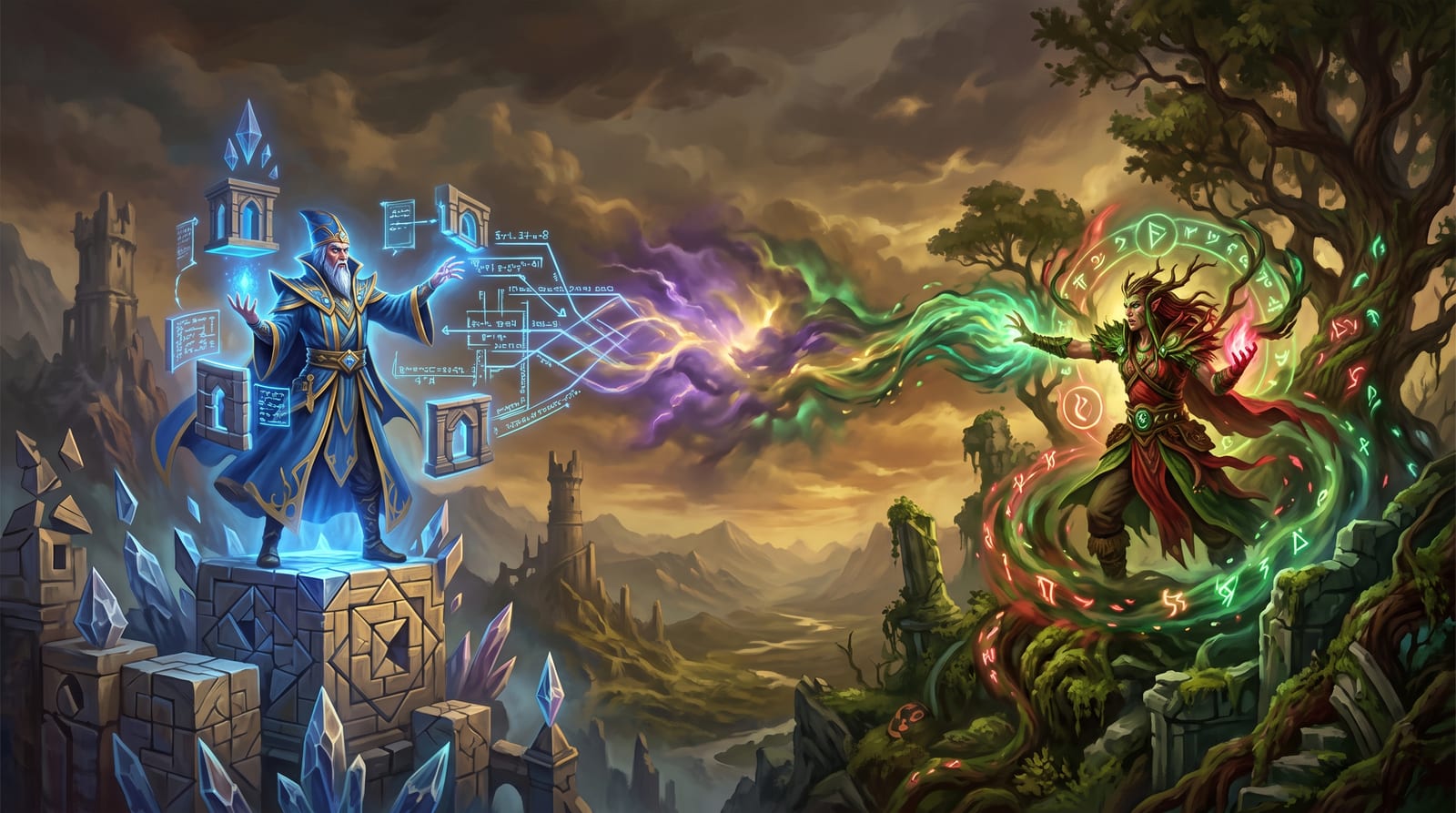
Moxfield vs Archidekt comes down to one question: do you want speed and a huge public deck library, or do you want to see your deck's role breakdown at a glance while you brew? Both are free web-based Magic: The Gathering deck builders, both are excellent, and both are missing the same thing: any real connection to the cards you actually own. Here's how they differ where it counts.
Moxfield vs Archidekt at a glance
Skim this first, then read the sections that matter to you.
| Category | Moxfield | Archidekt |
|---|---|---|
| Best for | Fast building, public deck sharing, sideboard testing | Visual brewing, seeing a deck's role breakdown |
| Deck organization | Custom tags, folders, "packages" for reusable card groups | Drag-and-drop categories (Ramp, Removal, Draw, Win Con) |
| Playtester | Widely considered the more polished of the two | Functional but fiddlier with card and zone movement |
| Community size | Larger public deck library and comment activity | Smaller but active, with forums and monthly contests |
| Commander bracket support | Built in, editable per deck | Built in, calculated from categorized cards |
| Mobile | Mobile-friendly site; a native app has been announced but isn't out yet | Progressive Web App (add to home screen), no native app planned |
| Cost | Free, optional $1/month Patreon to remove ads | Free, optional $2/month Patreon to remove ads |
| Collection tracking | Basic, not built for day-to-day inventory | Basic, not built for day-to-day inventory |
Both companies were built by small, independent teams, which is part of why they feel more like tools made by players than products made by a marketing department. It's also why neither has invested heavily in the one thing that would make the whole exercise more useful: knowing what's actually in your binder while you build.
How deck building actually feels
Open a new deck in Moxfield and you're editing text on the left with a live decklist on the right. Search is fast, autocomplete rarely misfires, and the "packages" feature lets you save a group of cards (say, a Reanimator package or a land base) and drop it into any future deck in one click. It's built for people who make a lot of decks and don't want friction between them.
Archidekt's pitch is different. Instead of one flat list, you drag cards into categories you define yourself: Ramp, Card Draw, Removal, Protection, Win Condition, whatever your deck needs. The deck page then visualizes the split, so you can see at a glance that you have plenty of removal and almost no ramp before you've even playtested a single game. For brewers who care about deck composition as much as raw card count, that view is genuinely useful, and it's the single biggest reason people pick Archidekt over Moxfield.
The tradeoff is interface density. Archidekt packs more controls onto the screen, and on a laptop or phone that can feel cramped compared to Moxfield's cleaner layout. If you're building on a bigger monitor it's less of an issue. For a wider look at how different builders approach this same tradeoff, see our roundup of the best MTG deck building tools.
Playtesting and stats
Both tools let you shuffle up a goldfish hand and play out turns without touching physical cards. Moxfield's playtester is generally the more reliable of the two: hotkeys for drawing, mulliganing, and moving cards between zones are quick to learn, and the battlefield stays legible even in a cluttered board state. Archidekt's playtester covers the same basics but is more prone to cards drifting out of position when you scroll or click near the battlefield, which matters more in a 100-card Commander game than a 60-card Standard deck.
Both generate a mana curve, color pie, and type breakdown automatically, and both flag legality issues against the format you've set, cross-checked against the same Oracle rulings you'd find on Scryfall. Neither runs a true probability simulation of your opening hand the way a dedicated hypergeometric calculator would, so treat the built-in stats as a sanity check, not a guarantee.
Community and deck sharing
Moxfield is the bigger public library by a wide margin. Publish a deck there and it's realistically discoverable, commentable, and forkable by other players within days. If you want feedback on a brew, or you're building a primer people will actually read, that audience matters.
Archidekt's community is smaller but not thin. It runs its own forums, hosts monthly deckbuilding contests, and its deck tags make it easy to browse by archetype: tokens, spellslinger, graveyard, and so on. For a wider sample of what other tables are playing, EDHREC aggregates public Commander decklists by card and archetype from across the format. If you're the kind of player who reads a primer before copying a decklist, that habit of evaluating a list critically instead of just netdecking it pays off more than the platform you build it on.
Pricing, imports, and moving between the two
Neither tool charges for the deck builder itself. Moxfield's Patreon starts at $1 a month and mainly removes ads; Archidekt's starts around $2 a month for the same. Nothing you'd call deckbuilding functionality sits behind a paywall on either site as of mid-2026.
Both accept plain-text decklist import and export, so moving a list from one to the other is a copy-paste job in most cases. The rough edges show up with format-specific quirks: modal double-faced cards and Archidekt's custom categories don't always survive a round trip cleanly, so double-check the imported list before you trust it for a tournament or a trade.
What neither tool does: know what you own
Here's the gap that shows up in almost every Moxfield vs Archidekt discussion once people get past the interface debate. Both are decklist tools first. Neither one was built to check your 99-card list against your actual binder, tell you which of the three "budget alternatives" for a $40 card you already own, or work when the internet drops mid-draft at your local shop.
That's the gap Grimoria was built to close, not to replace either builder for public sharing or brewing. Its deckbuilder includes a synergy graph and card suggestions that build directly from cards already in your collection, so a swap suggestion isn't just theoretically good, it's a card sitting in your binder right now. When a card in your list is expensive, the suggestion panel surfaces budget alternatives that serve a similar role, priced against live market data rather than a number that goes stale in a week. Add offline card scanning and a Commander deck generator, and it's less a Moxfield or Archidekt replacement than a third tool for the part of the hobby both of them leave out: what's actually on your shelf.
Which one should you use
If you publish decks publicly, want the largest audience for feedback, or run a lot of 60-card sideboard testing, start with Moxfield. If you want to see your deck's role composition while you build, or you like a smaller, contest-driven community, Archidekt earns the extra click. Plenty of players keep an account on both and pick per deck. Neither choice locks you out of the other; a text export takes thirty seconds.
Frequently asked questions
Is Moxfield or Archidekt better for Commander?
Both support the official Commander bracket system and have no card limits beyond format rules. Moxfield edges ahead for public sharing and playtesting; Archidekt edges ahead if you want a Commander deck's ramp, removal, and win conditions broken out visually while you build.
Is Moxfield actually free?
Yes. Every deckbuilding feature, including unlimited decks, custom tags, and the playtester, is free with no card or deck cap. Moxfield's Patreon starts at $1 a month and mainly removes ads and supports development. It does not gate any deckbuilding feature, so a free account can do everything a paid one can.
Does Archidekt have a mobile app?
Not a native one. Archidekt runs as a Progressive Web App, meaning you can add it to your phone's home screen from Safari or Chrome for an app-like experience, but there's no listing in the App Store or Play Store.
Can I move a deck from Moxfield to Archidekt or back?
Yes, both support plain-text decklist import and export, so copying a list between them usually takes under a minute. Watch for modal double-faced cards and Archidekt's custom categories, which sometimes need a manual fix after the import, and always compare the imported count against the original before you save it.
Which one has the bigger community?
Moxfield has the larger public deck library and more comment activity on shared decks, so a published list is more likely to get forked or discussed there. Archidekt's community is smaller but active, with its own forums, deck tags for browsing by archetype, and recurring deckbuilding contests.
Whichever one you open first, the decklist is only half the job. If you want the other half, comparing that list against the cards you already own and getting swap suggestions priced against real market data, try Grimoria's deckbuilder alongside it.